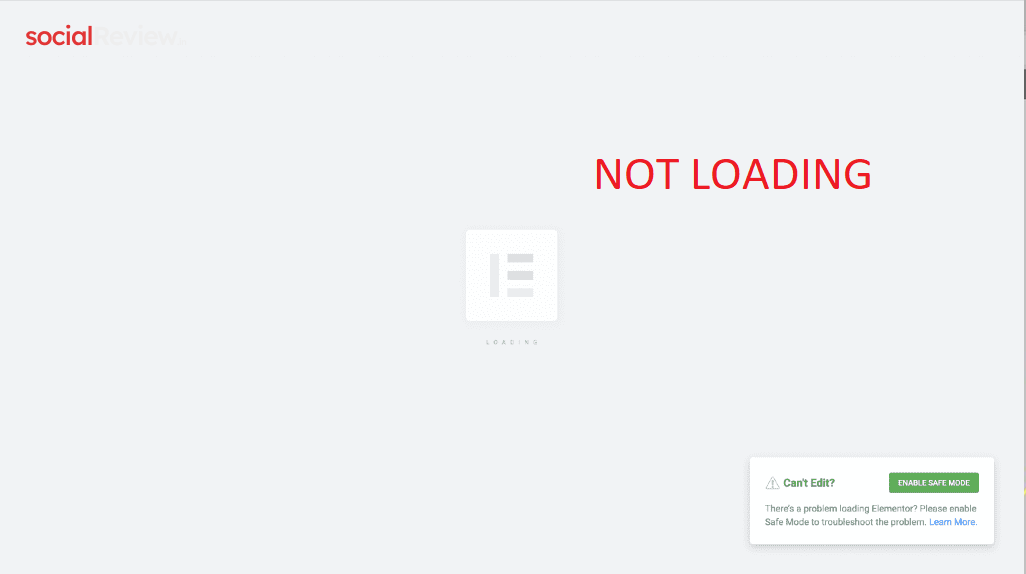
When Elementor exhibits a loading spinner that by no means finishes, a clean canvas, or a grey widget panel, the printed web page should stay accessible.

What the display screen exhibits is an editor initialization failure, not proof that the web page itself is broken. The public web page is serving content material that was already saved, whereas the editor should additionally load its scripts, WordPress information, preview iframe, and a contemporary server response.
Reloading the general public web page subsequently doesn’t check the identical work. A browser extension can block solely the modifying display screen, one broken widget can have an effect on just one web page, and a server can hold serving cached pages whereas rejecting the bigger requests Elementor wants in WordPress.
Before altering the stay website, examine the end result with the desk beneath. That single comparability prevents most pointless plugin, theme, and server modifications.
| What nonetheless works | What to verify first |
|---|---|
| The web page opens in one other browser or non-public window | A browser extension, cached editor file, or blocked website information. |
| Other Elementor pages and a brand new clean web page open | The affected web page’s newest widget, customized code, template, or saved information. |
| The editor opens in Safe Mode | A plugin, theme script, theme preloader, or customized code battle. |
| Every web page fails, together with in Safe Mode | Elementor/Pro compatibility, WordPress reminiscence, PHP errors, or a blocked server response. |
| The downside started after a website, staging, or HTTPS change | WordPress URLs, saved Elementor URLs, combined content material, and permalinks. |
| The console exhibits 403, 500, body, or cross-origin errors | The host, firewall, Cloudflare, or response headers moderately than the web page design. |
Create a present backup earlier than updating or rolling again Elementor, changing URLs, switching the stay theme, or deactivating plugins. Run battle assessments on a staging copy when the positioning handles orders, memberships, kinds, or different stay site visitors.
1. Find Out Whether the Failure Follows the Browser, One Page, or Every Page
The quickest helpful check isn’t an replace or reinstall. It is opening the identical editor in a clear browser session, then opening a distinct Elementor web page. The end result exhibits how a lot of the positioning is definitely affected.
- Open the affected web page in a non-public or incognito window utilizing a present desktop browser. Elementor’s editor isn’t supported as a cell or pill modifying atmosphere.
- If it opens there, return to the conventional browser and disable advert blockers, script blockers, privateness extensions, or antivirus browser add-ons for the positioning. Re-enable them one after the other after the editor works.
- Open a second Elementor web page. Then create an unpublished clean draft and choose Edit with Elementor.
- In WordPress, open Elementor > Editor > System. Some older Elementor builds present this as Elementor > System Info.
- Check the put in WordPress, PHP, Elementor, and Elementor Pro variations in opposition to Elementor’s present system necessities. Keep the free and Pro plugins on appropriate releases.

A stunning variety of Elementor loading failures begin with outdated WordPress, Elementor, Pro, theme, or PHP variations.
If solely the conventional browser fails, depart WordPress unchanged and proper the browser extension or website information. If just one web page fails, use Method 3. When each web page fails in a couple of browser, Safe Mode gives the following clear comparability.
If an replace is required, again up the positioning and check it on staging first. Update the free Elementor plugin earlier than Elementor Pro so the 2 don’t stay on mismatched variations.
2. Use Safe Mode to Prove a Plugin or Theme Conflict
Elementor Safe Mode opens the editor with out the lively theme and unusual third-party plugin code for the logged-in administrator. It doesn’t alter the model guests see, so it’s safer than deactivating the stay website’s plugins as the primary experiment.
This check isn’t wanted when the editor already opens and solely the printed web page seems to be unsuitable. Safe Mode additionally can not diagnose a widget panel that’s loading its personal third-party scripts.
- Open Elementor > Tools, set Safe Mode to Enable, and save the change. You also can settle for Elementor’s Safe Mode immediate when it seems on the failed editor.

If Elementor hundreds in Safe Mode, the editor is often superb and the conventional plugin or theme stack is what broke it. - Reload the identical web page. If solely the widget panel stays caught, be aware that end result: Elementor says Safe Mode doesn’t take away third-party scripts loaded inside that panel, so a failed panel isn’t a conclusive Safe Mode check.
- If the complete editor opens, use a staging website or a upkeep window to deactivate each plugin besides Elementor and Elementor Pro.

Elementor battle searching is often sooner while you strip the positioning down and reintroduce plugins steadily. - Test the editor, then reactivate the opposite plugins one after the other. Pay explicit consideration to Elementor add-ons, caching/minification instruments, safety plugins, and something up to date instantly earlier than the issue started.
- If no plugin reproduces the failure, check with Hello Elementor. Disable any web page preloader or customized script provided by the conventional theme earlier than changing the theme completely.
Elementor’s Safe Mode documentation confirms that guests proceed to obtain the conventional theme and plugins throughout this check.
If the editor fails once more when one plugin or the conventional theme returns, depart that merchandise disabled solely lengthy sufficient to replace it, appropriate its settings, or ask its developer for a compatibility repair. Check what the positioning loses earlier than leaving a required plugin disabled.
A failure that started instantly after an Elementor launch could require a known-good backup or Elementor’s Version Control rollback. Back up first, and hold Elementor and Elementor Pro on appropriate variations.
3. Check Memory and the Server Response When Every Page Fails
When Elementor fails throughout pages and browsers, the editor could also be exhausting WordPress reminiscence or receiving an incomplete PHP response. The printed website can nonetheless look regular as a result of cached front-end pages use fewer sources than the editor.
Elementor at the moment lists 256 MB because the WordPress reminiscence minimal for Elementor and Elementor Pro, with 512 MB beneficial. WooCommerce and different giant plugins could require extra.
Do not use this server methodology when just one web page fails or when the editor already works in one other browser. Those outcomes level elsewhere.
- Open Elementor > Editor > System and be aware the WordPress Memory Limit, PHP model, PHP reminiscence restrict, and any warnings.
- Reproduce the failure as soon as and be aware the time. Ask the host to examine the PHP error log, web-server log, and firewall log for that request.
- If WordPress reminiscence is beneath Elementor’s requirement, ask the host to increase each the WordPress and server-side PHP limits. Adding a
WP_MEMORY_LIMITworth can not exceed the ceiling enforced by the host. - Ask the host to appropriate any reminiscence exhaustion, deadly PHP error, execution timeout, failed write permission, ModSecurity block, or damaged compression response it finds.
- Reload the identical editor after the server change.

When Elementor stalls midway by means of loading, the true blocker is commonly reminiscence or a server rule moderately than the web page itself.
A visual 500 Internal Server Error belongs to this server-side verify. Our Elementor 500 error information covers the extra save and replace failures related to that code.
If correcting the logged PHP, reminiscence, or firewall error restores the editor, hold the confirmed server worth and take away any momentary debugging. If the host finds no failed request on the recorded time, proceed to Method 5 and check Elementor’s alternate loader.
4. Change Elementor’s Loader and Clear Only the Stale Editor Data
Elementor contains an alternate loader for servers that fail whereas decoding or returning the editor’s lengthy JSON response. This is particularly related when the browser console exhibits ERR_CONTENT_DECODING_FAILED or ERR_EMPTY_RESPONSE.
This setting isn’t wanted when the console already names a plugin battle, URL mismatch, or blocked body. Correct that particular error as an alternative.
- Open Elementor > Settings > Advanced.
- Set Switch Editor Loader Method to Enable, save the setting, and check the editor.

The loader methodology change helps when the usual editor boot course of fails in your present atmosphere. - Open Elementor > Editor > Tools > General and choose Clear Files & Data. Older Elementor variations label the identical upkeep motion Regenerate Files & Data.

Cached CSS or stale optimization information can hold Elementor damaged even after the unique battle is gone. - Purge the WordPress cache, host cache, and CDN cache. Then clear the saved information for this website within the browser moderately than deleting each browser session. Our single-site cache information exhibits that narrower cleanup.
- Close the outdated editor tab and open a contemporary one.
Elementor says the alternate loader is secure to depart enabled. If it fixes the editor, the host ought to nonetheless examine response compression and useful resource limits so the rationale for the unique loader failure is known.
For rollback, set Switch Editor Loader Method again to Disable. Keep regular caching enabled afterward and exclude solely WordPress admin/editor URLs that have been serving stale information.
If the editor hundreds after clearing the generated recordsdata, the cached copy was stale. If it nonetheless fails, proceed to Method 6 solely after a migration or HTTPS change; in any other case proceed to Method 7 for the console verify.
5. Correct Stored URLs After a Migration, Domain Change, or HTTPS Switch
Elementor hundreds its preview in a body. After a migration, the WordPress dashboard can use one area or protocol whereas Elementor’s saved information nonetheless requests one other, leaving the editor clean or filling the console with mixed-content and cross-origin errors.
Do not run a search-and-replace on a website that has not moved, and again up the database earlier than changing any URL.
- Open Settings > General. Confirm that WordPress Address (URL) and Site Address (URL) use the meant area and the identical
https://protocol.

Elementor usually breaks after migrations as a result of the editor and the positioning are nonetheless pointing at barely totally different URLs. - Open Elementor > Editor > Tools > Replace URL. Enter the precise outdated URL and new URL, overview each values, then run the substitute.
- Return to Tools > General and choose Clear Files & Data.
- Open Settings > Permalinks and choose Save Changes with out altering the construction.

URL substitute and a permalink refresh often matter most after staging strikes, cloning, or HTTPS modifications. - Clear the positioning and CDN caches, then reopen the editor. Reconnect the Elementor license if the area itself modified.
Elementor’s official URL-change directions use this substitute and file-clearing sequence.
If the WordPress deal with fields are locked, ask the host or website administrator whether or not WP_HOME and WP_SITEURL are outlined elsewhere earlier than modifying them.
6. Use the Browser Console to Identify Cloudflare, Iframe, or Firewall Blocking
A grey preview with purple console errors is extra helpful than one other reinstall. The console is helpful as a result of Elementor’s scripts and preview body are browser requests. The failed request identifies whether or not the browser, Cloudflare, firewall, or server rejected it.
Do not use this methodology to change body headers or firewall guidelines when the console exhibits no matching error. Those are safety controls, not basic efficiency settings.
- Right-click the clean editor, choose Inspect, open Console, and reload the web page.
- Match the purple error to the motion beneath.
| Console or Network end result | What to appropriate |
|---|---|
| 403 Forbidden | Ask the security-plugin supplier or host which firewall/ModSecurity rule blocked the Elementor request. Whitelist the required request moderately than disabling safety site-wide. |
| 500 or 503 | Give the host the time of the request and ask for the matching PHP and server-log entry. |
| Refused to show in a body or X-Frame-Options: DENY | Ask the host to enable same-origin framing. Elementor paperwork X-Frame-Options: SAMEORIGIN and a CSP frame-ancestors 'self' coverage as appropriate settings. |
| Mixed Content or cross-origin URL | Correct the saved HTTP/area URLs with Method 6. |
| Scripts delayed by Cloudflare Rocket Loader | Disable Rocket Loader for the WordPress admin and Elementor editor URLs, then purge Cloudflare’s cache. |
| An error names a theme or plugin script | Disable that plugin module, theme preloader, or customized code on staging and retest. |
If the editor hundreds after one focused rule or header correction, hold the narrower exception and restore any safety characteristic disabled for testing.
Download Elementor’s System Information and save the console message. Ask the host for the matching PHP and firewall logs.
If the editor nonetheless fails, embrace whether or not it really works in a non-public window, on one other web page, and in Safe Mode when contacting Elementor. Those outcomes establish the failed request way more clearly than an inventory of updates and reinstalls.